

The Penthouse Cat
How to create a beautiful, feline-ready residence without turning a considered home into a pet store.
A penthouse is not made luxurious by square footage alone. It becomes luxurious when every object has a purpose, every surface has a point of view, and nothing—least of all the cat’s necessities—looks like an afterthought.
The premise is simple: your cat deserves a home that works beautifully for its instincts, while you deserve a home that still looks like yours. The answer is not to hide the animal. It is to design for it with the same discipline applied to a bar cabinet, dressing room, or bespoke bookshelf.
A genuinely feline-friendly interior accounts for a cat’s need for elevated areas, places to rest, scratching opportunities, and separated food, water, and toileting resources. In other words, good cat design is not indulgence. It is functional hospitality.
I. The Litter Cabinet Privacy, Not Punishment
A litter tray need not dominate a room. But concealment must never come at the cost of access, size, ventilation, or your cat’s willingness to use it. The best solution is a custom or furniture-grade cabinet with a discreet side entrance, a generously sized internal compartment, wipeable surfaces, and doors that open wide for daily cleaning.
Location matters more than the finish. Place the cabinet in a quiet, low-traffic area, away from food and water. A tray should be roughly one-and-a-half times the cat’s body length from nose to tail base, and cats benefit from choices rather than a single, inaccessible facility.
Think fluted oak or ebonized ash; unlacquered brass pulls; a stone or lacquered top; a silent-close door; and a side entry that does not force the cat to make an awkward U-turn. This is cabinetry first, litter management second.

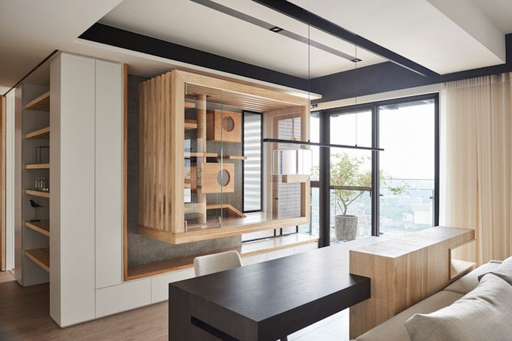
Build Upward, Not Outward
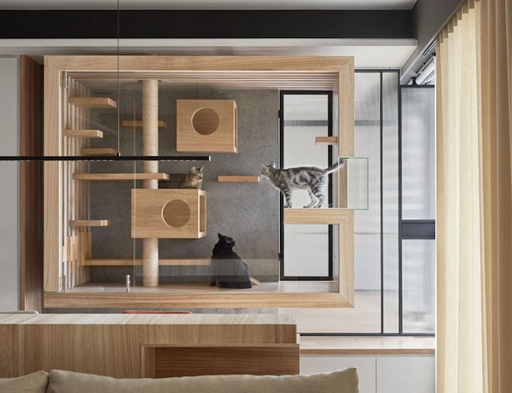
A wall of shelves, a library ladder adapted into a climbing route, or a made-to-measure run of timber ledges gives a cat a commanding view without surrendering visual calm at floor level.
The most successful cat architecture is vertical. Elevated areas expand a cat’s usable territory and offer a secure vantage point from which to observe its surroundings. In a multi-level apartment, consider vertical circulation as seriously as you would a staircase for guests.
Avoid the obvious faux-carpet tower in the middle of an otherwise beautiful room. Instead, ask a millworker to create staggered oak platforms within a bookcase, a discreet step system near a window, or a ceiling-height climbing wall finished in the same timber as your joinery. Add a wool or felt landing pad only where the cat will actually sleep.
The result is not “cat furniture.” It is a sculptural elevation system with a very particular client in mind.
III. Material Intelligence Let the Room Age Gracefully
Cats will scratch. This is not a moral failing, a behavioral betrayal, or a reason to cover the entire apartment in plastic. It is normal feline behavior. The intelligent owner creates approved places for it, then selects surrounding materials with composure.
For upholstery, favor performance velvet, tightly woven wool, heavy linen blends, or leather with a finish designed to acquire character. Avoid open weaves, delicate bouclé in high-traffic feline zones, and anything so precious that a single claw becomes a household emergency. For floors, timber, stone, and substantial rugs survive real life—and generally look better for it.
Place a tall scratcher or wall-mounted scratching panel where your cat already wants to scratch. A cat needs a place to extend fully, and a well-positioned panel is far more elegant than correcting a behavior your room failed to anticipate.
A Feeding Station, Properly Done
The feeding station should not be a fluorescent corner of mismatched bowls. Treat it as a small service bar: contained, cleanable, and quietly handsome.
A shallow drawer can hold food, supplements, and grooming tools; a stone or stainless tray protects the floor; and a filtered water source belongs nearby but not necessarily beside the food. A discreet niche in the pantry, a low cabinet in the utility room, or a recessed station at the end of a kitchen run will feel far more deliberate than a pair of bowls stranded beside a refrigerator.
In a multi-cat residence, do not force a shared dining arrangement merely because it photographs nicely. Separate feeding spaces and visual separation can reduce competition and give each cat a more relaxed routine.
V. Natural Light Design for the Sun
Every cat deserves at least one place in the home where the light arrives beautifully. A deep window ledge, a custom bench, a low leather ottoman near a view, or a softly upholstered bay-window perch can become the day’s preferred address.
This is the easiest luxury in the article: do not overdesign it. Give the cat a safe perch, a pleasant view, a washable throw, and enough room to turn around. It will handle the rest. Light is the original feline amenity.
Designed for Both of You.
The goal is not a home surrendered to a cat. It is a home made more intelligent by one. The litter cabinet becomes real furniture. The climbing wall becomes an architectural gesture. The feeding station becomes a composed detail. And the sunlit perch becomes the best seat in the house—which, as your cat has always known, it was anyway.


